Data & Trust
Show Me Your Comp Set, I'll Show You Mine

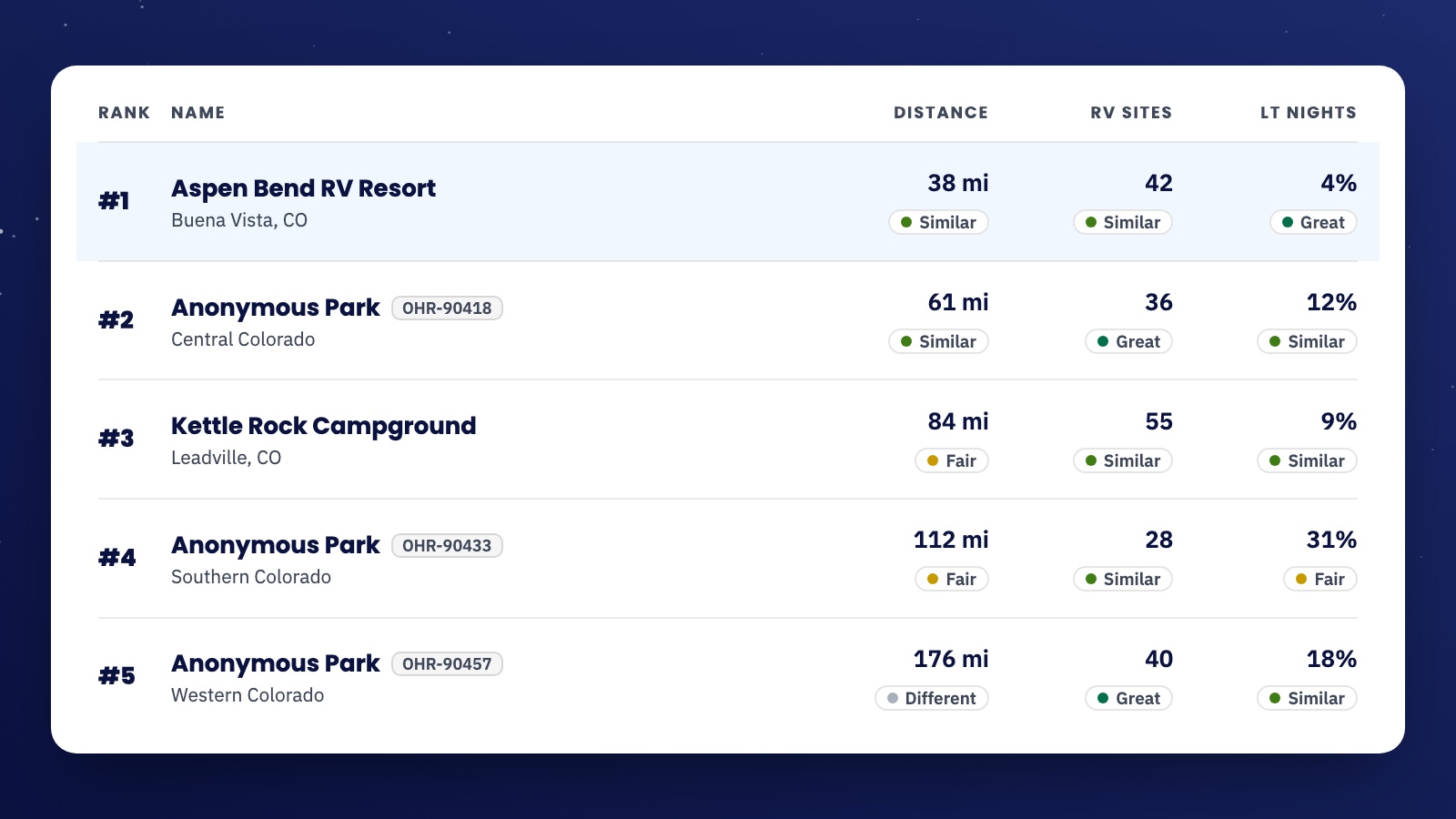
Benchmarking has a trust problem. Everybody wants better market data. Everybody wants to know how the comp set is performing. Everybody wants to see occupancy, rate, pace, and revenue trends.
Then somebody asks: "Okay, who else is contributing data?" And suddenly the room gets quiet.
Fair question. If benchmarking is built on shared data, operators should have confidence that the data is coming from real, relevant businesses. That does not mean everybody needs to see everyone else's revenue. It means there is value in knowing who is actually at the table.
Anonymous Sounds Safe. It Can Also Feel Mysterious.
Imagine someone tells you: "Five comparable parks contributed to this benchmark." Naturally, your next question is: "Which five?" Not because you want their financial statements. Because you want to know whether they are actually comparable.
Are they destination RV resorts? Seasonal parks? Luxury glamping properties? Long-term communities? A campground three states away that happens to have the same number of sites?
The identity of participating properties helps establish confidence in the benchmark. The individual results can still remain protected. Those are two different things.
Transparency Makes the Comp Set Better
Let's say your comp set includes five properties. Your occupancy is 82%. The aggregated comp set occupancy is 76%. Your occupancy index is:
Great. But that 108 becomes much more useful when you understand who makes up the comparison group. If those properties genuinely compete for similar demand, the benchmark has meaning. If they do not, the math can be perfectly accurate and still be practically useless. That is why transparency around participation matters.
Sharing Does Not Have to Mean Exposing
This is where people sometimes hear "data sharing" and picture their competitor getting an email that says "Steve's RV Resort ADR: $127.43." No. That is not the idea.
A thoughtful benchmarking model can separate two things: participant identity, and individual performance results. Operators can know which properties participate in a market while the actual benchmarking results are presented as aggregated market data.
That means you can know who is contributing without necessarily knowing exactly what Property A charged last Saturday. You get confidence. The market gets context. Nobody has to start hiding behind the propane tanks.
Why Operators Should Be Willing to Participate
Benchmarking gets stronger when more relevant operators contribute. Pretty simple equation:
If everyone wants to receive market intelligence but nobody contributes, benchmarking does not work particularly well. It is a little like showing up to a potluck with an empty casserole dish and asking what everybody else brought.
Participation is the deal. You contribute your data under clearly defined rules. Other operators contribute theirs. Everyone gets a better view of the market.
The Real Risk Is Often Not Knowing
Operators understandably worry about sharing business data. They should ask questions. Who can access it? How is it stored? How is it aggregated? What can other operators see? What does the agreement actually allow? Those are healthy questions.
But there is also another business risk: making major decisions without market context. You might lower rates because occupancy looks soft, when the entire market is softer. You might celebrate record revenue, when comparable properties grew twice as fast. You might assume you are priced aggressively, when the market is twenty dollars above you.
Keeping every number isolated can feel safe. It does not necessarily make decision-making safer.
Trust Comes From Clear Rules
Good benchmarking requires more than technology. It requires trust. Operators should understand what information is collected, how it is used, who participates, how individual property performance is protected, and how aggregated benchmarks are created.
There should not be any magic curtain. Nobody should have to send data into some mysterious black box and simply hope for the best. The cleaner the rules, the easier participation becomes.
Where OHR Fits
OHR's goal is to create useful market intelligence through trusted participation. That means building comp sets that operators can believe in, while protecting individual property performance appropriately.
The point is not "show everybody your numbers." The point is "let's know who is contributing so we can trust the comparison." That creates something outdoor hospitality needs more of: credible market context, because benchmarking gets a lot more useful when you know the people sitting at the table are actually playing the same game.
Frequently asked questions
Can I see which properties are in my comp set?
OHR is built to let operators know which properties are participating in a comparison, while keeping individual performance results aggregated and protected.
Will other operators see my individual numbers?
No. Individual property performance stays protected. Only aggregated, comp-set-level results are shared back.
Why does participant transparency matter if results are anonymous?
Knowing who's in a comp set lets you judge whether the comparison is actually relevant to your property, which is different from needing to see their specific numbers.
Why should I contribute my own data?
Benchmarking only works when enough relevant operators participate. Contributing your own data is what makes the market intelligence you receive back meaningful.
What's the actual risk of not participating?
Making pricing and strategy decisions without market context, which can look safe in the short term but lead to under- or over-pricing relative to where the market actually sits.